
By Joe Sgroi, Knight ATV · November 10, 2026
Some of the best rides of the year happen after the sun goes down. The air is cooler, the trails are quieter, and a mud park lit up by a few dozen machines is something you don't forget. Daylight saving time ended November 1, so for a lot of us the sun is down before we even get the ATV off the trailer. If you ride this time of year, you're going to ride in the dark.
I'm Joe Sgroi, founder of Knight ATV. We ride at night a lot, from late trail loops to the after-dark sessions at RATS Offroad Park. These are the ATV night riding tips we actually use: what to check before you leave, how to see, how to be seen, and what the rules say about lights.
Quick answer
The most important ATV night riding tips:
- Check every light before you leave: headlight high and low, tail light, brake light and reverse light. Wipe the lenses.
- Aim your headlight so the bright spot lands on the trail, not in the treetops or in other riders' eyes.
- Never outride your headlight. Ride slowly enough to stop inside the distance you can actually see.
- Be seen from behind with a bright red tail light and a working brake light. A white reverse light helps you back up and lets riders behind you know you're backing.
- Ride trails you already know, spread the group out, and use the buddy system.
- Watch for wildlife, especially deer in the fall.
- Wear clear eye protection (never tinted at night) and add something reflective.
- Know the law. On public land, you generally need a working headlight and tail light from a half hour after sunset to a half hour before sunrise, and many public OHV areas close at sunset.

Before you ride: the pre-ride light check
The ATV Safety Institute's pre-ride checklist (T-CLOCS) includes lights and switches: make sure all of your lights work before every ride. At night that check matters more than anything else on the list. It takes two minutes:
- Headlight, high and low. Switch through both beams with the engine running. If one bulb is out, fix it before you go. ASI also suggests carrying a spare headlight bulb in your tool kit.
- Tail light and brake light. Have a buddy stand behind the machine while you squeeze the brake lever and press the foot brake. Michigan's ORV law, for example, requires a brake light brighter than the tail light for night riding.
- Reverse light. Shift into reverse and make sure it comes on, then make sure it goes off when you shift out.
- Clean lenses. A film of dried mud can cut your light output a lot. Wipe the headlight and tail light before you head out and again after the first mud hole.
- Switches you can find by feel. Before dark, practice reaching your light switch, high/low beam and kill switch without looking down.
- Battery and charging. Lights, a winch and a sound system all pull from the same battery. Start the night with a healthy one.

Aim your headlight
A headlight that points too high lights up the trees and blinds oncoming riders. One that points too low leaves you riding into a short pool of light. Most ATVs have a headlight beam adjuster. Yamaha's Grizzly 700 owner's manual, for example, shows an adjusting screw that raises or lowers the beam, and Yamaha suggests having a dealer make the adjustment.
Pennsylvania's ATV law gives a good target. It says a single-beam headlight should be aimed so that, with the machine loaded, none of the bright part of the beam at 75 feet ahead is higher than the center of the headlight. On a machine with high and low beams, the low beam has to light up people and vehicles at least 50 feet ahead. To check yours, sit on the ATV with your normal load, park facing a flat wall or your trailer door, and look at where the bright spot lands. It should sit at or a little below the height of the headlight itself.
Some states also limit how you use extra lights. Wisconsin, for example, limits how many bright front lamps you can run at once near oncoming vehicles. It also requires you to dim high beams, light bars and other extra lights within 500 feet of an oncoming vehicle or one you're following.

Never outride your headlight
California's Offroader Safety Course study guide notes that night ATV crashes usually involve running into trees, rocks, fences or other stationary objects that show up in the headlight beam without warning. Its rule is simple: you should always be able to stop within the length of your headlight beam. It says an ATV high beam is effective for about 200 feet and that you should travel slower than 30 mph, because stopping from 30 takes about 180 feet. ASI's rule for hills applies to the dark, too: never ride past the limit of your visibility.
What that looks like on the trail:
- Slow down more than you think you need to, especially on the first loop of the night.
- Slow way down at crests and blind corners. ASI says to keep right and assume another rider is coming the other way.
- Use landmarks in open fields. The California course notes that distance and direction are hard to judge in a big open area after dark, so pick a reference point, like a light at camp or a tree line.
Read the terrain differently in the dark
Your headlight flattens everything out. Shadows hide how deep a rut is, a puddle looks the same whether it's two inches or two feet deep, and a mud hole that was easy at noon can look completely different at midnight.
- Ride trails you rode in daylight. Save new trails for the daytime.
- Walk the water and the big mud holes first with a flashlight. If you can't see the bottom, don't guess.
- Don't follow tire tracks blindly into water. For water crossings, the Polaris owner's manual sets the maximum depth at the bottom of the footrests. We covered line choice and water depth in more detail in our ATV mud riding tips.
- Use 4WD before you need it. Getting stuck in the dark is twice the work. If yours has been slow to engage, see what to check when your ATV won't shift into 4WD before the next night ride.

Be seen from behind: tail, brake and reverse lights
At night, other riders don't see your ATV. They see your lights. Your headlight tells people coming toward you where you are. Everyone behind you, whether it's your buddy, a rider coming up fast or a truck at a road crossing, is going off your tail light and brake light. The rules agree on how far that light should reach. Wisconsin requires a red tail lamp plainly visible from 500 feet during darkness, and the Bureau of Land Management requires red taillights visible from 500 feet at night on its land.
A lot of factory tail lights are small, dim, or hidden under racks, bags and mud. A few things help:
- Keep the tail light clear. Don't strap gear bags, coolers or gas cans over it.
- Make sure the brake light is obviously brighter than the running light, so the rider behind can tell you're stopping.
- Upgrade to a brighter LED tail light if yours is dim or cracked.
- Add a white reverse light so you can see where you're backing and the riders around you know you're backing up. Wisconsin allows up to two white or amber backup lamps on an ATV, but only lit when you're backing. It also says the tail lamp has to be on whenever the backup lamp is.

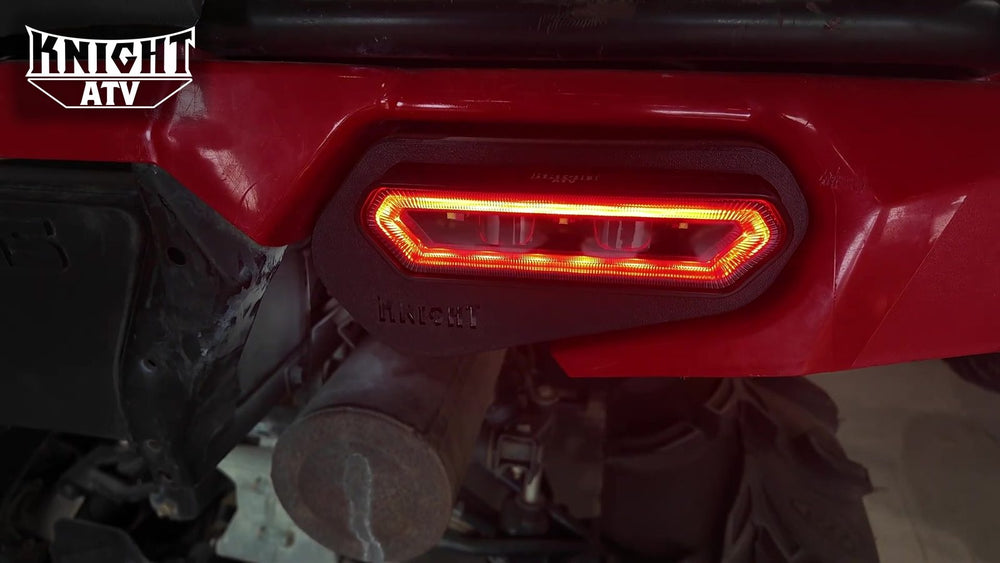
The Knight ATV tail light with reverse
I designed our tail light because most ATVs don't come with a reverse light, and riding at night shouldn't mean squinting at a dim red glow. Every model puts three lights in one housing:
- A running light with an under light, so the back of your machine is easy to spot.
- A bright brake light.
- A 15-watt, 2,000-lumen white reverse light.
It mounts in the stock location and plugs into the factory harness with no cutting or splicing. With the standard setup, the reverse light only comes on when you shift into reverse, which is exactly what Wisconsin's backup-lamp rule expects. If you'd like to turn it on yourself, for example to light up your work area while you're parked, add the toggle switch option (+$24.99). The Brute Force and Polaris lights also have a strobe function that you can wire to a switch, and we're happy to help you set it up.
"Amazing light! Night riding is gonna be awesome now that I have this light." — Logan, Honda Tail Light with Reverse
"Lights are bright and work as they should." — Kevin, Brute Force Tail Light w/Reverse
"Great reverse light output as well as the taillight." — Corey Kunkle, Arctic Cat Tail Light with Reverse Light

Prices from knightatv.com on November 10, 2026:
| Tail light | Price |
|---|---|
| Honda Tail Light with Reverse (Foreman, Rancher, Recon, Rubicon, 2026 Rubicon 520) | $169.99 ($194.99 with toggle switch) |
| Brute Force Tail Light w/Reverse (all Brute Force and Prairie, oval or rectangle) | $169.99 ($194.99 with toggle switch) |
| Prairie 360 Tail Light with Reverse | $194.99 |
| 2016+ Yamaha Grizzly 700 Tail Light with Reverse | $169.99 ($194.99 with toggle switch) |
| 2016+ Yamaha Kodiak 700 Tail Light with Reverse | $169.99 ($194.99 with toggle switch) |
| 2018+ Yamaha Kodiak 450 Tail Light with Reverse | $169.99 ($194.99 with toggle switch) |
| 2007 to 2019 Yamaha Grizzly Tail Light with Reverse | $169.99 ($194.99 with toggle switch) |
| Arctic Cat Tail Light with Reverse Light | $169.99 ($194.99 with toggle switch) |
| Polaris LED Tail Light with Reverse Light (Sportsman, RZR, ACE and more; reverse light runs on a switch) | $379.99 |
| Honda P500 Tail Light with Reverse | $169.99 ($194.99 with toggle switch) |
See them all in the tail lights with reverse collection. Wondering whether a reverse light is worth it for you? We answered that in Do You Need a Reverse Light on Your ATV?

Brute Force riders who run a light bar can also put everything under one thumb with our Control Switches Box ($89.99 for 2012+ Brute Force, $94.99 for 2000–2011 Brute Force 650/750 and Prairie 650/700). It has a three-position light switch (off, low beam, and high beam plus light bar), a winch switch, two extra push buttons for accessories, and a USB port. That's easy to work in the dark with gloves on.
Ride as a group, and space it out
Riding with friends is the best part of night riding, and it's also safer. ASI recommends the buddy system: ride with at least one other person, and make each rider responsible for keeping track of another. Before you leave, tell someone at camp or at home where you're going and when you'll be back.
- Spread out more than you would in daylight. Dust hangs in a headlight beam and kills your vision. Give the rider in front enough room that you're not riding in their dust, and keep the rider behind you in sight.
- Stop at every turn and trail split until the rider behind you catches up.
- Use your brake light as a signal. Tap it before you slow down so the rider behind knows what's coming.
- Dim your high beam and light bar when you're following someone or meeting another rider.
- Cross roads the ASI way. Cross at a 90-degree angle where you can see well. The first rider crosses and waves the group over, and the last rider watches traffic. ASI warns that drivers may not see you, because they're looking for cars, not ATVs.


Watch for wildlife
Deer move the most around dawn and dusk, and the Iowa DNR calls those low-light hours "deer-heavy." Fall is the worst time of year. The Iowa DNR says bucks are most active from the middle of October until the third week of November during the breeding season. A driver watching the first deer that crosses can miss the buck chasing it. The DNR's advice for drivers works on an ATV too:
- Slow down, especially near brushy creeks, tree lines and fence lines.
- Sweep your eyes from side to side, ditch to ditch, not just down the middle of your beam. Animal eyes often shine in your lights before you can make out the animal.
- Expect a second animal right behind the first.
- Don't swerve hard. Brake in a straight line. Veering off the trail at night can put you into a tree or a ditch you can't see.

Gear and reflective items for night riding
- Clear eye protection. ASI says to always use clear eye protection at night. Leave the tinted goggles in the truck.
- A DOT helmet. Michigan, for one, requires ORV riders to wear a DOT-approved crash helmet and protective eyewear, with a few exceptions such as riding on your own property.
- Something reflective. Reflective tape on your helmet, rack and rear fender, or a reflective vest, makes you visible even if your lights are blocked.
- A headlamp or flashlight for walking water crossings, fixing a flat or finding the trailer hitch.
- Warm layers. Nights get cold fast in the fall, and cold hands react slower on the brake.
- Your phone, charged and dry. A waterproof phone mount like our SafeBox keeps your map and flashlight within reach.
- Stay sharp. ASI notes that alcohol and drugs hurt your judgment, and that marijuana decreases your ability to see at night and recover from headlight glare. Fatigue does the same, so call it a night before you're worn out.

What the law says about ATV lights at night
The rules depend on where you ride, so check your state and the land manager before you go. Here's what the main ones say:
- National forests: Federal rule 36 CFR 261.15(c) prohibits operating any vehicle off National Forest System, state or county roads from a half hour after sunset to a half hour before sunrise unless it has working head and tail lights.
- BLM public land: 43 CFR 8343.1(d) requires headlights that light an object at 300 feet at night, and red taillights visible from 500 feet. Vehicles with four or more wheels need at least two headlights and two taillights.
- Many public OHV areas close at night. Sequoia National Forest lists Cyrus Canyon OHV Area as open sunrise to sunset, Stanislaus National Forest's Black Springs OHV Area is day use only, and Daniel Boone National Forest bans motorized use of the White Sulphur OHV Trail System from sunset to sunrise from May 1 to November 30. Night riding is usually a private-land or mud-park activity, so check the park's hours.
- State examples: California (Vehicle Code §§ 38335 and 38345) requires a headlight that lets you see 200 feet ahead and a red taillight visible for 200 feet between sunset and sunrise. Michigan (MCL 324.81133) requires a lighted headlight and taillight from a half hour after sunset to a half hour before sunrise, plus a brake light brighter than the taillight. Pennsylvania (75 Pa.C.S. § 7741) requires lights in that same window and anytime you can't see 500 feet ahead because of fog or bad weather. New York (VTL § 2406) requires a lighted white headlight and red taillight from a half hour after sunset to a half hour before sunrise. Wisconsin (§ 23.33(6)) requires a lighted headlamp and tail lamp every time you ride, day or night.
- Public roads: ASI reminds riders that ATVs are designed for off-road use only and shouldn't be ridden on public roads. Some towns and counties do open roads as ATV routes, so follow your local rules exactly.
Most riders say it's easiest to just keep your headlight and tail light on whenever you ride. The New York DMV recommends it, and in Wisconsin it's the law.
FAQ
Is it legal to ride an ATV at night?
In most places, yes, as long as your ATV has working lights and the riding area is open. On national forest land, federal rule 36 CFR 261.15 requires working head and tail lights from a half hour after sunset to a half hour before sunrise. Many states have the same rule. Many public OHV areas close at sunset, though, so check the hours. On private land and at mud parks, follow the park's rules.
What lights does an ATV need for night riding?
At minimum, a working white headlight and a red tail light. Many states also require a brake light. For example, California requires a headlight that lets you see 200 feet ahead, and Wisconsin and the BLM want a red tail light visible from 500 feet. A white reverse light isn't required, but it makes backing up at night much easier and safer.
How fast should you ride an ATV at night?
Slow enough to stop within the distance your headlight lights up. California's Offroader Safety Course says an ATV high beam reaches about 200 feet and recommends staying under 30 mph, since stopping from 30 takes about 180 feet. On tight or unfamiliar trails, go much slower than that.
What should I wear for ATV night riding?
A DOT helmet, clear goggles or a clear visor (never tinted at night), gloves, boots and warm layers. Add something reflective on your helmet, your back or your rack, and carry a flashlight or headlamp.
Do I need a reverse light on my ATV for night riding?
It's not required, but it helps a lot. A white reverse light lets you see where you're backing, like on a trailer ramp, a dead-end trail or the edge of a mud hole, and it tells riders around you that you're backing up. The Knight ATV tail light with reverse adds a 2,000-lumen reverse light in the stock tail light location.
How do I keep my group together at night?
Use the buddy system, so each rider keeps track of another. Spread out enough to stay out of each other's dust, stop at every turn until the rider behind catches up, and tap your brake light before you slow down. Tell someone at camp where you're going and when you'll be back.
Get out there after dark
Night riding is some of the most fun you can have on an ATV. Check your lights, aim the headlight, slow down, and make sure the rider behind you can see you. Then go enjoy the trail. Need a place to ride? Our state guides cover the mud parks and public trails in Texas, Louisiana, Mississippi, Alabama and Florida. Not sure which tail light fits your machine? Text a photo of your current tail light to 732-737-7761 and we'll point you to the right one.
Follow Knight ATV for night rides, mud runs and new builds on YouTube, Instagram, Facebook and TikTok. Watch our "Light up the dark" short to see the reverse light in a dark shop, and the Polaris LED tail light with reverse install video.
Sources: ATV Safety Institute, Tips and Practice Guide for the All-Terrain Vehicle Rider (T-CLOCS pre-ride check, eye protection, visibility, road crossings, buddy system, alcohol and drugs); 36 CFR 261.15; 43 CFR 8343.1; USDA Forest Service pages for Cyrus Canyon OHV Area, Black Springs OHV Area and the White Sulphur OHV Trail System closure order; California State Parks OHMVR, Operation / Equipment Requirements (CVC §§ 38335, 38345); California Offroader Safety Course study guide, "Beware of Darkness"; Michigan MCL 324.81133; Pennsylvania 75 Pa.C.S. Chapter 77, § 7741; New York DMV, ATVs: Information for Owners and Operators and NY VTL § 2406; Wisconsin Statutes § 23.33(6); Iowa DNR, "Drivers stay alert for deer movement 2026" (October 13, 2026); Yamaha Grizzly 700 Owner's Manual, "Adjusting a headlight beam," via the Yamaha manual store; Polaris owner's manual, "Driving Through Water"; knightatv.com product pages for the tail lights and Control Switches Box listed above (prices checked November 10, 2026); Judge.me customer reviews on knightatv.com; Knight ATV YouTube videos.


